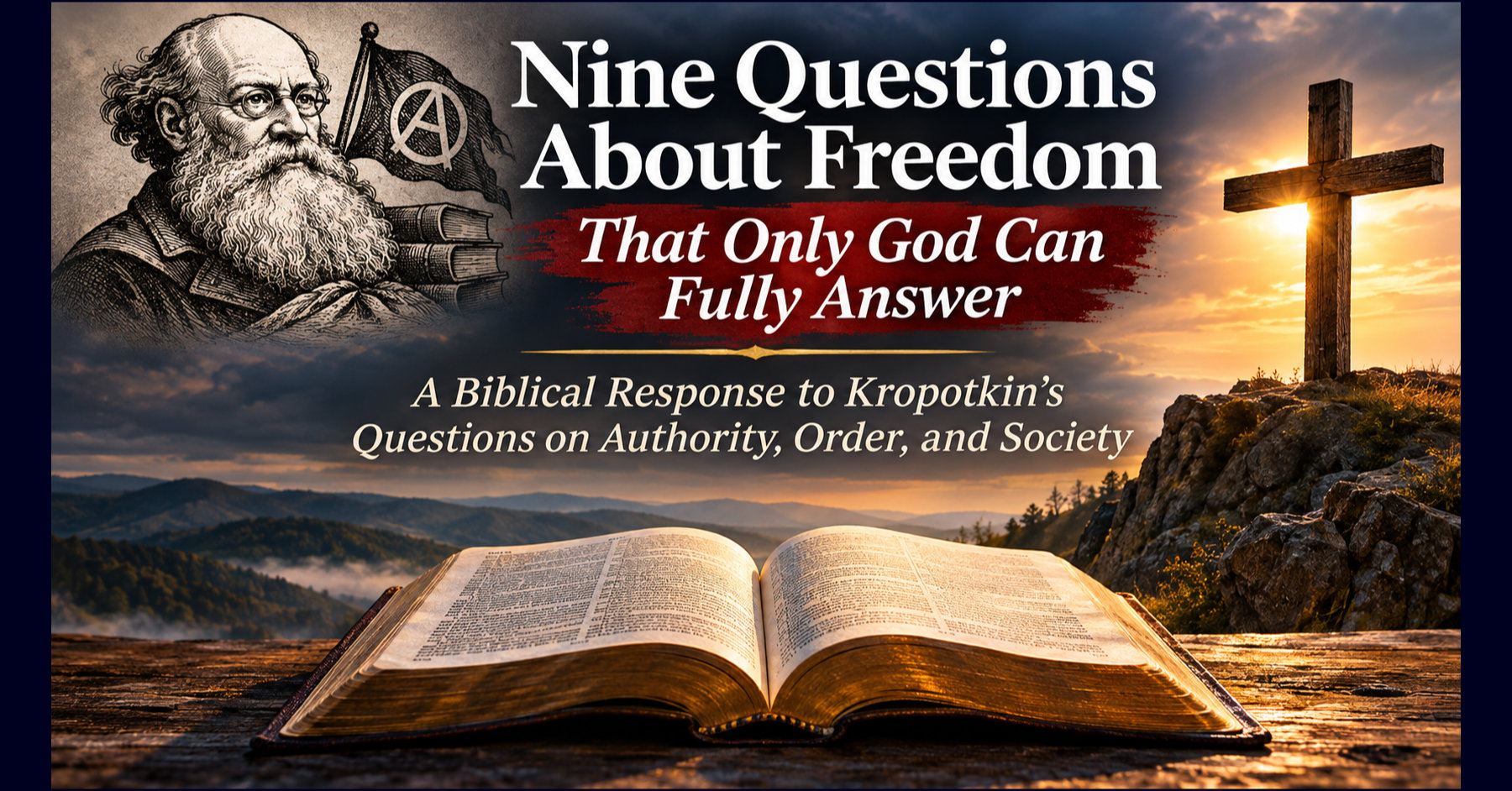
Why removing human authority cannot solve the deeper problem of human nature.
Nine questions attributed to the Russian philosopher Peter Kropotkin have been circulating on social media. They challenge authority, question economic inequality, celebrate cooperation, and suggest that humanity might flourish without the institutions that govern society.
At first glance, many of these questions sound reasonable. Who hasn’t questioned an unjust authority? Who hasn’t wondered why some people accumulate extraordinary wealth while others struggle to survive? Who doesn’t believe that cooperation, generosity, and compassion are better than exploitation and cruelty?
As a Christian, I find several of these concerns entirely legitimate.
But there is a profound difference between identifying what is wrong with society and correctly identifying why it is wrong.
And there is an even greater difference between proposing a society that sounds morally attractive and understanding what makes human beings moral in the first place.
Kropotkin was an influential advocate of anarchism and mutual aid. He envisioned social cooperation organized through voluntary associations rather than centralized government. His philosophy challenged the assumption that coercive authority was necessary for human civilization.
Yet Scripture raises a question that reaches deeper than political philosophy:
What happens when we remove external authority but leave the sinful human heart unchanged?
That is where a biblical examination of these nine questions must begin.
1. Why Do We Obey?
The first question challenges obedience rooted in habit rather than reason.
There is wisdom in examining why we follow authority. Blind obedience has enabled terrible injustices throughout human history.
But Scripture does not teach that all authority is inherently oppressive or that independence from authority is the highest expression of freedom.
Romans 13:1 tells us:
“Let every soul be subject unto the higher powers. For there is no power but of God: the powers that be are ordained of God.”
This passage establishes the legitimacy of governing authority, not the moral perfection of every government or official.
When human authority commands what God forbids, or forbids what God commands, Scripture establishes a higher obligation.
Acts 5:29 declares:
“We ought to obey God rather than men.”
The Christian position is neither unquestioning submission to human rulers nor rejection of all authority.
It is obedience governed by a higher moral standard.
The question is not whether we should obey authority. It is whether that authority is exercising its responsibilities in accordance with God’s righteousness.
2. What Creates Real Order?
The second question presents a choice between government coercion and voluntary cooperation.
But why must we assume these are mutually exclusive?
Scripture recognizes both the necessity of civil order and the extraordinary value of voluntary cooperation.
Romans 13:4 describes the governing authority as a minister of God for good, including the responsibility to restrain wrongdoing.
Meanwhile, the early Christian church demonstrated remarkable voluntary generosity.
Acts 4:32 describes believers who were united in heart and soul and shared their possessions.
Their cooperation was not produced by government compulsion. It emerged from their shared faith.
Yet the Bible also explains why human goodwill cannot be the only foundation of social order.
Jeremiah 17:9 warns:
“The heart is deceitful above all things, and desperately wicked: who can know it?”
Human beings are capable of extraordinary generosity. They are also capable of extraordinary cruelty.
A society built entirely upon the assumption that everyone will voluntarily behave justly overlooks the biblical reality of sin.
Real order requires moral responsibility, justice, accountability, and a recognition that human nature is imperfect.
Government cannot manufacture righteousness. But neither can voluntary cooperation guarantee it.
3. Who Benefits From Scarcity?
The third question asks why a few control the surplus when there is supposedly enough for everyone.
Scripture certainly condemns greed, exploitation, and the accumulation of wealth through injustice.
James 5:4 speaks directly against those who withhold wages from laborers.
Proverbs 22:22 commands:
“Rob not the poor, because he is poor: neither oppress the afflicted in the gate.”
There is no biblical justification for exploiting the vulnerable.
But the question contains an assumption worth examining: that scarcity exists primarily because some people control resources.
Scarcity can arise from many causes, including environmental limitations, failed harvests, inadequate infrastructure, war, mismanagement, and human greed.
Redistributing existing resources does not automatically create additional resources or guarantee their responsible management.
Nor does Scripture teach that possessing wealth is inherently sinful.
Abraham was wealthy. Job possessed considerable resources. Joseph administered Egypt’s food reserves in preparation for famine.
The moral issue was not simply possession. It was stewardship.
Luke 12:48 reminds us:
“For unto whomsoever much is given, of him shall be much required.”
God does not condemn prosperity simply because it exists. He condemns injustice, greed, and the failure to use what we possess responsibly.
The biblical answer to scarcity includes generosity, productive stewardship, justice, and care for those in need.
It does not begin with the assumption that every inequality is evidence of wrongdoing.
4. Is Competition Truly Natural?
The fourth question suggests that cooperation may be a deeper human instinct than competition.
Here, Christians should recognize an important truth.
God did not create humanity for isolation.
Genesis 2:18 declares:
“It is not good that the man should be alone; I will make him an help meet for him.”
Human beings were created for relationships, families, communities, and shared responsibilities.
The New Testament repeatedly calls believers to cooperate, serve one another, and bear one another’s burdens.
Galatians 6:2 states:
“Bear ye one another’s burdens, and so fulfil the law of Christ.”
But cooperation and competition are not necessarily opposites.
Competition can encourage diligence, innovation, excellence, and personal development. Cooperation can enable people to accomplish things no individual could achieve alone.
Either can become destructive when corrupted by selfishness.
Competition driven by envy can become exploitation.
Cooperation without accountability can become collective irresponsibility.
Scripture does not establish cooperation as morally superior in every circumstance or competition as inherently evil.
Instead, it examines the motives behind our behavior.
Philippians 2:3 instructs:
“Let nothing be done through strife or vainglory; but in lowliness of mind let each esteem other better than themselves.”
The Christian objective is not to eliminate competition. It is to eliminate selfishness as the governing motive of human relationships.
That requires a transformation no economic or political system can accomplish on its own.
5. What Is the Cost of Power?
The fifth question asks whether power protects people or inevitably corrupts those who possess it.
History provides abundant evidence that power can be abused.
The Bible provides the same warning.
When Israel demanded a king, Samuel warned that kings would take their sons, daughters, fields, servants, and resources for their own purposes.
The warning in 1 Samuel 8 is remarkably relevant to discussions of concentrated political authority.
God did not pretend that rulers would always govern justly.
He warned His people about the dangers.
But Scripture also provides examples of righteous leadership.
Joseph used his authority to preserve lives during famine.
Daniel served within powerful governments while remaining faithful to God.
Nehemiah exercised governmental authority to rebuild Jerusalem and protect its people.
The biblical problem is not the existence of power. It is the misuse of power.
Jesus offered a radically different model of leadership.
Mark 10:43 declares:
“But so shall it not be among you: but whosoever will be great among you, shall be your minister:”
In Christ’s kingdom, greatness is expressed through service.
Power becomes dangerous when leaders begin treating authority as personal ownership rather than entrusted responsibility.
Eliminating formal government does not eliminate power. Influence, wealth, intimidation, and control can emerge wherever human beings interact.
The absence of an official ruler does not guarantee the absence of domination.
6. Can Freedom and Solidarity Coexist?
The sixth question asks whether individual liberty must be sacrificed for the common good.
The Bible rejects the idea that freedom and responsibility are inherently incompatible.
Galatians 5:13 states:
“For, brethren, ye have been called unto liberty; only use not liberty for an occasion to the flesh, but by love serve one another.”
This is one of the clearest biblical descriptions of genuine freedom.
Christian liberty is not permission to disregard others.
It is an opportunity to serve them willingly.
The Christian is called to exercise freedom within the boundaries of love, truth, and moral responsibility.
That is fundamentally different from defining freedom as the absence of all restraint.
A person who is free to exploit others is not demonstrating Christian liberty.
A community that suppresses individual conscience in the name of collective welfare is not necessarily practicing Christian love.
The biblical relationship between freedom and responsibility is rooted in the commandment to love our neighbors as ourselves.
Freedom without love becomes selfishness. Solidarity without freedom can become coercion.
Christ calls us to something better than either extreme.
7. What Makes Crime Flourish?
The seventh question asks whether crime originates in human nature or in conditions of inequality and exclusion.
The biblical answer recognizes that social conditions can influence behavior.
Poverty, injustice, neglect, and exploitation can create circumstances in which crime becomes more prevalent.
A just society should address those conditions.
But Scripture does not teach that wrongdoing originates exclusively in economic or social circumstances.
Jesus said in Mark 7:21–22:
“For from within, out of the heart of men, proceed evil thoughts, adulteries, fornications, murders, Thefts, covetousness, wickedness, deceit, lasciviousness, an evil eye, blasphemy, pride, foolishness:”
Notice where Jesus locates the source of wrongdoing.
Within the human heart.
Wealthy people commit crimes.
Poor people commit crimes.
Educated people commit crimes.
People living under oppressive governments commit crimes, and people living in comparatively free societies commit crimes.
Social conditions can influence the frequency and forms of wrongdoing, but they do not fully explain its existence.
Romans 3:23 declares:
“For all have sinned, and come short of the glory of God;”
This is not an argument for ignoring poverty or injustice.
It is an argument against believing that correcting external conditions will automatically correct human character.
A better society can reduce opportunities and incentives for wrongdoing. Only spiritual transformation addresses the deeper problem of sin.
8. Do We Need the State to Be Moral?
The eighth question asks why government is necessary if people can demonstrate generosity and justice without it.
This question confuses two separate issues.
The source of morality is not the same as the purpose of government.
Christians do not believe that government creates moral truth.
God is the ultimate source of moral authority.
Romans 2:14–15 explains that even those without the written law can demonstrate an awareness of moral obligations through conscience.
Human beings can recognize wrongdoing without receiving instructions from government.
But the existence of moral awareness does not guarantee moral obedience.
Knowing that stealing is wrong does not prevent every theft.
Recognizing that murder is evil does not eliminate murder.
Understanding justice does not ensure that everyone practices it.
Civil government serves a different function.
At its best, it provides a framework for public order, adjudication, protection, and the restraint of wrongdoing.
These institutions remain accountable to moral standards higher than themselves.
The Bible never presents government as humanity’s savior.
Nor does it teach that the abolition of government would produce universal righteousness.
We do not need government to define good and evil. We need moral accountability because human beings do not consistently choose good over evil.
And government itself must remain subject to that accountability.
9. What Kind of Society Truly Liberates Humanity?
The final question contrasts a society built on domination and profit with one built on mutual aid and freedom.
It is an appealing contrast.
But it is also incomplete.
Christians should reject domination, exploitation, and the worship of wealth.
We should affirm compassion, generosity, mutual assistance, and human dignity.
Yet the Bible teaches that humanity’s deepest bondage is not merely political or economic.
It is spiritual.
John 8:34 records Jesus saying:
“Verily, verily, I say unto you, Whosoever committeth sin is the servant of sin.”
A person can live under a democratic government and remain enslaved to greed.
A person can possess substantial wealth and remain enslaved to pride.
A person can reject every political authority and remain enslaved to hatred, envy, or selfish ambition.
External freedom is valuable.
But external freedom alone cannot liberate the soul.
Jesus provides the answer in John 8:36:
“If the Son therefore shall make you free, ye shall be free indeed.”
That is the fundamental difference between a political philosophy of liberation and the Christian understanding of freedom.
Political philosophies seek to reorganize human relationships.
Christ seeks to redeem human beings.
A just society matters. Compassion matters. Freedom matters. Responsible government matters.
But none of these can replace the transforming power of Jesus Christ.
The Question Missing From All Nine
There is something striking about these nine questions.
They examine authority, order, scarcity, competition, power, solidarity, crime, morality, and freedom.
Yet they never directly confront the question upon which all the others ultimately depend:
Why do human beings knowingly choose evil when they understand what is good?
We know generosity is better than greed, yet greed persists.
We know honesty is better than deception, yet people lie.
We know compassion is better than cruelty, yet cruelty continues.
We know justice is better than oppression, yet human history is filled with oppression.
And these failures are not confined to one political system, economic arrangement, or social class.
They follow humanity wherever humanity goes.
This is precisely what the Bible teaches about our fallen condition.
The prophet Jeremiah identified the deceitfulness of the human heart.
The apostle Paul explained the universality of sin.
Jesus identified the heart as the source of evil and offered redemption as the answer.
Political reform can improve institutions.
Economic reform can address injustice.
Education can improve understanding.
Social cooperation can strengthen communities.
These are worthwhile pursuits.
But none of them can redeem the human soul.
The Difference Between Changing Society and Changing Humanity
There is a reason the Christian faith has survived empires, revolutions, political movements, and competing economic philosophies.
Its central message does not depend upon the success of any human institution.
Christianity begins with the recognition that humanity needs something greater than better government, greater prosperity, or more equitable social arrangements.
We need reconciliation with God.
Second Corinthians 5:17 declares:
“Therefore if any man be in Christ, he is a new creature: old things are passed away; behold, all things are become new.”
Notice what Scripture promises.
Not merely a new political arrangement.
Not merely a redistribution of resources.
Not merely the removal of authority.
A new creature.
The transformation begins within the individual and extends outward into relationships, families, communities, and institutions.
A transformed heart does not guarantee a perfect society. Christians remain imperfect, and even religious institutions can become corrupt.
But the Gospel addresses the moral condition that no political philosophy can finally resolve.
And that is why I cannot accept the suggestion that human liberation can be achieved simply by dismantling existing structures of authority.
The same human beings who abuse power within governments can abuse power outside them.
The same greed that corrupts markets can corrupt communal arrangements.
The same selfishness that damages institutions can damage voluntary associations.
Changing the structure does not automatically change the people who inhabit it.
Final Thoughts: Freedom Begins With Truth
I believe we should question authority.
I believe we should challenge injustice.
I believe we should defend the vulnerable, oppose exploitation, encourage generosity, and hold powerful people accountable.
Scripture gives us compelling reasons to do all these things.
But I do not believe humanity’s ultimate problem is the existence of authority, competition, wealth, or government.
Our ultimate problem is sin.
And our ultimate hope is not found in anarchism, capitalism, socialism, democracy, or any other human system.
Our hope is found in Jesus Christ.
That does not excuse us from working toward a more just society. Quite the opposite. Our faith should compel us to demonstrate God’s love through our conduct and our treatment of others.
But we must never confuse improving the human condition with redeeming the human soul.
The nine questions attributed to Kropotkin invite us to imagine a better society.
The Gospel invites us to become new people.
And that is where genuine freedom begins.
“And ye shall know the truth, and the truth shall make you free.” — John 8:32 (KJV)
Leave a Reply